
DK-MN participants share hopeful reflections following Leadership Gathering

In the fall of 2024, the United Methodist Council of Bishops (COB) announced there would be a denomination-wide gathering in 2026 for a different purpose than legislation and debate. The hope was that the gathering would create a space for attendees to dream and discern where God might be leading the denomination in the future.
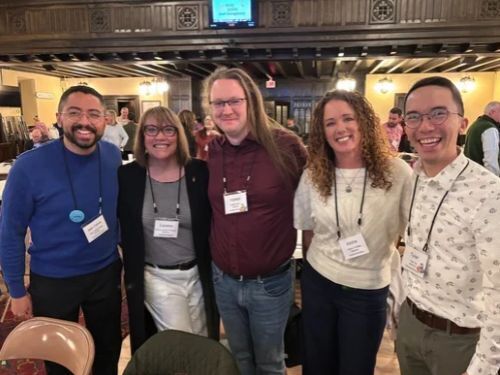
The Dakotas-Minnesota Area delegation.
As COB president in 2024, Bishop Tracy S. Malone described, “This leadership gathering will provide the discernment space where intergenerational and interdisciplinary spiritual leaders will assemble to do generative, missional, innovative and strategic thinking together.” The event's purpose was articulated in the theme of the gathering: “Emboldened by the Spirit: Imagining a Church Yet to Be.”
In addition to active bishops, retired bishops who serve as Council of Bishops officers, leaders from the general agencies and the Connectional Table, each Bishop invited three participants from their episcopal areas – a clergy member, a lay member, and at least one member age 35 or younger. Additional individuals were invited to ensure a variety of voices were at the table.
Rev. Tyler Sit, Alisha Vincent, Walker Brault, and Rev. Jean Carlos Diaz, along with Bishop Lanette Plambeck, were the members from the Dakotas-Minnesota Area who attended the gathering in Calgary, Alberta, Canada.
“I felt really humbled to be chosen for this, so I put intentional energy into bringing as much of Minnesota with me as possible,” shared Rev. Sit. “I reflected a lot on the stories of ministry not only from the congregations I’ve pastored but the stories I’ve heard from churches across the state, particularly rural churches.”
Heading into the event, attendees weren’t entirely sure what to expect. However, a common sentiment echoed through several conversations. “I was hopeful that it would not just be a conversation that got put in a report that ended up on shelves in the archives, but it would actually lead to some lasting and meaningful change in our denomination,” described Brault, who serves as the Database Administrator and Conference Secretary for the Minnesota Annual Conference.
While they may not have known exactly what to expect from a gathering of this size of United Methodist clergy and laity from around the world, several things stood out as unique and refreshing.
“I am overjoyed to be a part of a movement that is not only local, but worldwide, that has global implications,” Diaz shared in a video message during the event.
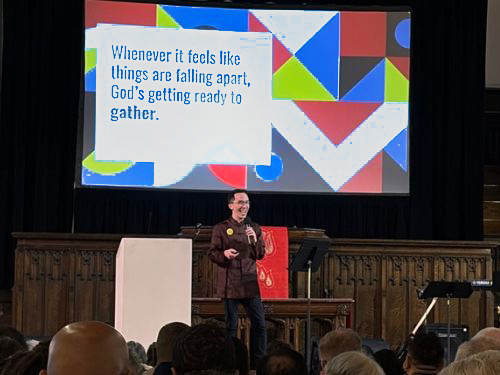
Rev. Tyler Sit, of the Minnesota Conference, presented at the Leadership Gathering.
“I appreciated that the room wasn’t completely filled with people who normally get invited to denominational gatherings,” shared Vincent. “Instead, there were a lot of people under 35, several laity who represented various contexts and backgrounds, and diversity of culture that could speak to contexts across the worldwide connection.” Vincent joined the Dakotas and Minnesota Methodist Foundations as the vice-president of programs and operations this year after serving as faculty and director of the Practical Church Leadership program at Dakota Wesleyan University in Mitchell, SD.
"Our worship and teaching sessions were a true means of grace, connecting us to one another and inspiring us for the work ahead," shared Bishop Lanette. "To stand alongside sisters and brothers from around the world was a living reminder that we are a connectional church, part of something far larger than ourselves."
"My one sorrow is that unfortunate visa issues and the Ebola outbreak kept many of our siblings, primarily from Africa, from joining us in person. While many joined virtual sessions, their voices and presence are essential moving forward," she added.
For Sit, the experience motivated him to dispel some of the narratives that circulated leading up to the event.
“I think there’s a mystique around the Leadership Gathering that I would like to promptly dispel,” explained Sit. “When I talk to people, there’s a sense that this was some shrouded meeting where secret plans were being brokered. But, really, it felt like the best parts of Annual Conference—getting to know people I wouldn’t have met otherwise, worshiping heartily, and dreaming of a future that I don’t have the headspace for in my day-to-day ministry life. The Bishops and general agency leaders were very disciplined in their active listening, which I really appreciated.”
Rev. Sit, pastor of Northeast United Methodist Church in Minneapolis and Associate Director of Multicultural Ministry for the Minnesota Conference, had the opportunity to speak at the gathering about resisting authoritarianism through Christian discipleship. He described how the rise of authoritarianism is a symptom of poor discipleship. He challenged every United Methodist to gather 25 others to follow Jesus and authentically care for people in their community, showing how this simple act could defeat authoritarians worldwide.
While the event may have resembled a General Conference gathering, it also had stark differences.
“The biggest similarity was that it was United Methodists from around the world getting to build on that connection,” described Brault, who has served as a lay delegate to General Conference for the Minnesota Conference. “But it was a completely different vibe in the room. We weren't there to go through Robert's Rules of Order and deal with a bunch of legislation. We were there to dream and imagine outside of those constraints.”
“It let us be more real with each other,” he added. “We didn't have to deal with the constraints that Robert's Rules puts on us, and we could be more collaborative in our approach.”
As those conversations took place, naming present hard realities and what people from different countries or demographics are experiencing around the world, examples of hope and possibility were lifted.
“What's really encouraging for me is that actually, in Africa, in the Philippines, they have huge movements of young people in the church. And so it's not like it's impossible. God is already doing that work in the church,” said Rev. Diaz. “But I think it's time for the United States to learn from our global brothers and sisters, who are reaching young people in dynamic ways. Inside the walls of the church and outside the walls of the church, um, really meeting the needs of young people, um, and empowering young people to be leaders.”
This message of empowering and equipping young people echoed through the gathering, not as a disconnect from our current mission, but as a call to action to our congregations and conferences.
“Emphatically, the gathering emphasized that we need to be the most innovative with our ministry with children and young people,” said Sit. “What would it be like if United Methodists met with the top experts in pedagogy, child mental health, and social development? What would a students-first church look like in 2026, when kids are facing chaos and distractions? As it turns out, the very best place to experiment with that is the very congregations that we are in right now!”
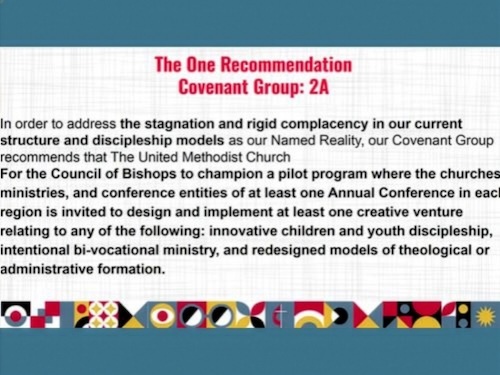
"We heard a clear desire for opportunities to deepen formation in the Wesleyan tradition, training in discipleship pathways and evangelism, skill development in community engagement and organization, and more intentional worldwide partnership," said Bishop Lanette. "The priorities that emerged resonate deeply with what we are already hearing from our faith communities and what our staff and connectors are planning toward together."
The Dakotas-Minnesota contingency carried that spirit of possibility and drive to act on it back to the Area. They also brought back a desire to fan into flame that spark of the Holy Spirit that lives in our congregations and communities.
“This is simple, but I was reminded that the local church really is the best testing grounds for innovation,” explained Sit. “Conference bodies and general agencies do incredible, critical work that, at its best, is innovative as well. But innovation in practices (like in worship, small groups, etc.) are best discovered in the laboratory of the local church.”
Vincent echoed that sentiment. “I also think bureaucracy gets in the way of progress too often. I would love to see United Methodists in local contexts better resourced to lead in their respective areas,” said Vincent. “The best people to carry out the kind of change that we need to see are not necessarily the ones sitting around the annual or general conference decision desks but rather the ones who are working on new solutions to engaging young people, inviting business leaders into conversations, and showing up to start a new small group.”
“As a denomination, we need to be more courageous about deploying resources toward the future of the denomination and the people who are going to lead it,” she added.
“My hope is that we won't just say that we care about young people, but that we will put action and energy, money, resources so that in 20 years, our annual conferences, in 30 years, 50 years, will have a church that's characterized by every generation,” added Diaz.
“I hope that this type of gathering happens again, that we can have these imaginative conversations that eventually lead to change and that we're doing that dreaming and imagining and figuring out where we feel the Holy Spirit moving us before we turn to the actual practices and language for the Book of Discipline that we need to make that a reality,” said Brault.
“This has just been the beginning of a larger conversation that I feel like everyone here is being called to, and I look forward to engaging this conversation when I get back home with my friends and neighbors across our connection in the Dakotas, as we dream together and actually live into a reality that is bold and courageous and loving in our local context,” said Vincent. “I feel like that's what we've been called to do.”
“I just want to emphasize, this is the beginning of a global conversation, not the end of it,” added Sit.
The event concluded with participants sharing 16 recommendations to help The United Methodist Church flourish that emerged from small group conversations at the event. The Council of Bishops is expected to share a report shaped by these recommendations in January.
Alisha Vincent would welcome the opportunity to gather with other Dakotas United Methodists to continue this conversation and share how these recommendations resonate in the Dakotas. If you are interested in being a part of this, please share your contact info so we can reach out to you to set a time.